Faith Without Feet: When Belief Refuses to Move
How Genuine Faith Moves Beyond Prayer and Belief into Obedience, Action and Purpose.

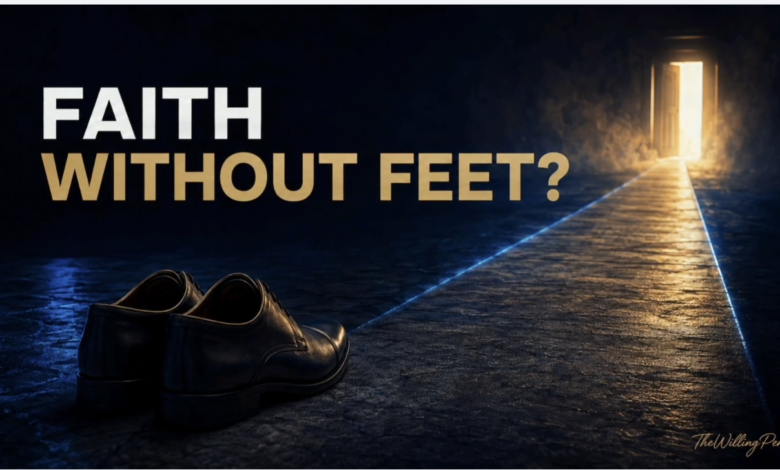
Waiting for God to do everything can become a recipe for stagnation. Trusting Him is essential to the Christian life, but expecting Him to do what He has already entrusted to us is not necessarily faith. Sometimes, it is avoidance clothed in spiritual language. Scripture presents a clear relationship between divine grace and human responsibility: God works in us, and we respond by working faithfully. He provides direction, wisdom, strength and opportunity, while we respond through obedience, courage, discipline and stewardship. Purpose does not unfold through passivity, but through faith that is willing to move.
Christ’s redemptive work is complete. At Calvary, the price of salvation was fully paid, sin and death were defeated, access to God was opened, and every promise of God found its ultimate “Yes” in Christ. Nothing can be added to that finished work, and nothing needs to be repeated. Yet what Christ accomplished for us must still be received, lived out and expressed through us. There is a difference between what God has made available by grace and what becomes visible in our lives through faithful obedience.
Salvation is a gift, not a reward for human effort. Nevertheless, the life that flows from salvation is not passive. Grace does not eliminate responsibility; it empowers it. God may open a door, but we must be willing to walk through it. He may order our steps, but we must still take them. He may place an opportunity before us, but we must recognise, prepare for and respond to it. God never intended for purpose to arrive in idle hands.
The Christian life is therefore not a choice between grace and effort. It is the meeting point of divine empowerment and human response. Paul expressed this balance clearly when he wrote, “Work out your own salvation with fear and trembling, for it is God who works in you to will and to act in order to fulfil his good purpose” (Philippians 2:12–13). Paul did not say that we work for salvation. He said that we work out what God has already worked within us. God provides both the desire and the power, but we must express them through obedience.
This pattern runs throughout Scripture. Nehemiah prayed about the broken walls of Jerusalem, but he also approached the king, assessed the damage, organised the people and participated in rebuilding the city. Joshua received God’s promise of victory over Jericho, but Israel still had to march around the city according to God’s instructions. Noah believed God’s warning about the flood, but his faith became visible through the long and demanding work of building the ark. Esther trusted in God’s providence, but she still had to enter the king’s presence at the risk of her life. In every case, God spoke and His people moved.
This is why the expression “faith without feet” is so important. Feet represent movement, direction and response. Faith may begin in the heart, but it was never designed to remain there. It must eventually find expression in the choices we make, the risks we take, the work we undertake and the instructions we obey. Faith without feet may sound convincing, but it cannot carry anyone into purpose.
Dependence on God remains the foundation of the Christian life. Jesus made it clear that apart from Him, we can do nothing of lasting spiritual value. Yet dependence must not be confused with inactivity. Some people have quietly turned “trusting God” into an excuse for avoiding responsibility. They pray for a harvest but never plant a seed. They ask for wisdom but refuse to study. They seek employment but submit no applications. They desire restored relationships but avoid honest conversations. They pray for better health while resisting every opportunity to develop healthier habits.
They repeatedly declare that “God will make a way” while ignoring the doors He has already opened. This may not always be faith. Sometimes, it is fear protected by religious vocabulary. Sometimes, it is procrastination given a spiritual appearance. It enables people to remain in the same position while convincing themselves that their inactivity is evidence of trust in God.
Prayer is not a substitute for obedience. Prayer prepares us, directs us and strengthens us to obey. If our prayers never lead us to act when God has already made our responsibility clear, we may not truly be waiting on God. We may simply be postponing something we are afraid or unwilling to do.
There are, of course, genuine seasons in which God instructs us to wait. Biblical waiting, however, is not careless inactivity. It is attentive, expectant and obedient. A farmer waiting for a harvest does not abandon the field. The farmer prepares the soil, plants the seed, removes the weeds and protects what has been planted. The farmer cannot command the rain or force the seed to grow, but there is still work to be done while waiting for the increase. In the same way, waiting on God should involve preparation, faithfulness and readiness—not paralysis.
God will not ordinarily do for us what He has assigned us to do. He may inspire a book, but He will not sit at the desk and write it. He may provide a business idea, but He will not develop the plan, contact the customers or manage the finances. He may convict us about a damaged relationship, but He will not apologise on our behalf. He may call us towards greater physical and emotional wellbeing, but He will not establish our daily habits for us. God empowers human agency; He does not erase it.
Our obedience often becomes the bridge between promise and experience. This does not mean that human effort can manipulate God or guarantee every outcome we desire. It means that we are responsible for acting faithfully on what God has placed before us while leaving the final result in His hands. We prepare the ground and plant the seed, but God gives the increase.
Scripture repeatedly emphasises this responsibility. Proverbs 16:3 instructs us to commit our work to the Lord so that our plans may be established. There must first be work to commit and plans to surrender. James 4:17 tells us that anyone who knows the right thing to do and fails to do it commits sin. Colossians 3:23 commands us to work heartily, as unto the Lord rather than merely for people. Romans 14:12 reminds us that each person will give an account of themselves to God. Together, these passages show that stewardship, diligence, obedience and accountability are not alternatives to faith; they are evidence of faith.
James makes the point unmistakably: faith without works is dead. In other words, faith without feet cannot travel. It cannot carry a vision into reality, turn conviction into obedience or transform intention into impact. It may speak confidently, attend services regularly and repeat powerful declarations, yet remain exactly where it began.
Noah’s faith picked up tools. Abraham’s faith left familiar territory. Moses’ faith returned to Egypt. Rahab’s faith protected the spies. David’s faith confronted Goliath. Peter’s faith stepped out of the boat. Esther’s faith entered the throne room. Their actions did not replace their trust in God; their actions revealed it. None of them controlled the outcome, but each accepted responsibility for the next act of obedience.
Taking action does not mean trusting God less. When that action is guided by prayer and grounded in obedience, it demonstrates that we trust God enough to move at His word. Faith is not merely agreeing that God can do something; it is responding to what He has said with our lives.
However, rejecting passivity does not mean embracing restless self-reliance. Not every opportunity represents God’s direction, and not every delay amounts to disobedience. There are times to advance and times to remain still, times to speak and times to be silent, times to build and times to wait. The answer to passivity is not frantic activity; it is obedient action.
Before moving, we should pray, examine Scripture, seek wisdom and listen to godly counsel. But once the direction is sufficiently clear, endless deliberation can become another form of resistance. We must not continue asking for new instructions simply because we are uncomfortable with the last ones we received. Discernment should lead to obedience, not become a permanent hiding place from it.
Sometimes, the entire journey will not be visible before we begin. God may reveal only the next step. That step might involve making a telephone call, submitting an application, beginning a course, writing the first page, seeking forgiveness, asking for help or ending a destructive habit. We do not always need complete certainty about the destination before responding faithfully to the instruction already before us.
We must also learn to use what God has already placed in our hands. Moses had a staff. David had a sling. A widow had a small amount of oil. A young boy had five loaves and two fish. None of these resources appeared sufficient for the challenges involved, but each became significant when surrendered to God and used faithfully. Obedience begins not with what we wish we had, but with what we already possess.
You are not merely a passenger in your own story. You are an ambassador entrusted with a commission. God will not pack your bags, complete your application, apologise on your behalf or initiate the difficult conversation you keep avoiding. He will provide grace, wisdom and courage, but the step remains yours to take. Responsibility is not a burden placed in opposition to faith; it is one of the privileges of partnering with God.
Stop waiting for lightning when God has already opened a door. Stop asking for another confirmation when fear is the only reason you have not obeyed the first instruction. Stop calling inactivity “discernment” when the next faithful step is already clear. Faith without works is not merely unproductive; it can become deceptive because it creates the feeling of spiritual progress while leaving us exactly where we began.
Purpose is not a parcel that will simply be delivered to our doorstep. It unfolds within a living relationship with God through listening, trusting and responding. God speaks, and we respond. God guides, and we step. God empowers, and we persevere. That is what it means to give faith feet.
Faith must do more than speak. Faith must stand. Faith must walk. And when God calls, faith must be willing to move.
